Agricultural Engine, 1825
Introduction
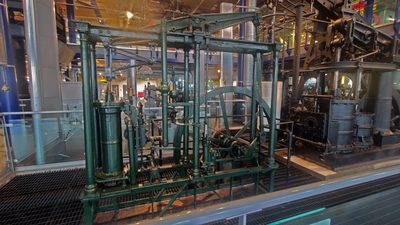
This engine was used by several firms over 125 years, including John Hall and Co at Stourbridge, who used it until 1951. In addition to being used to drive a chaff cutter on a farm, it was also used to lift tubs of coal at a colliery and power a machine to grind fireclay at a quarry.
Small steam engines were used on farms to operate a wide range of agricultural machinery. Built 25 years before the first fully portable engine was made in Birmingham, semi-portable engines were taken to a site — like a farm — and installed there to do a specific job.
Facts and Figures
- Manufacturer: Not known
- Date built: 1825
- User: John Hall and Co, unknown—1951
- Period of use: 1825-1951
- Location: Stourbridge, unknown—1951
- Engine type: Double acting rotative semi-portable beam engine
- Power output: 2—3 horsepower / 1.5—2.2 kilowatts
History
This semi-portable engine built in 1825 was an early attempt to make steam power more accessible for outdoor use. When it moved to a new location, it only needed a wall to be built at the back for support. A boiler was also needed to supply the steam. The first portable engine was built in 1850 by Richard Bach of Bach and Co, Birmingham. Throughout its 125 years of use, the engine was employed on a wide variety of tasks at collieries, quarries and on farms.
Steam engines brought about a revolution in agriculture in the nineteenth century. They were employed for many different tasks including threshing, ploughing and cultivating. At first semi-portable or stationary engines were installed in barns on large farms or estates. Portable engines were then introduced to power heavy machinery such as threshing machines, and to aid ploughing and cultivating. Often, portable engines were bought by contractors who travelled around the countryside offering their services to the farmers.
What's Special
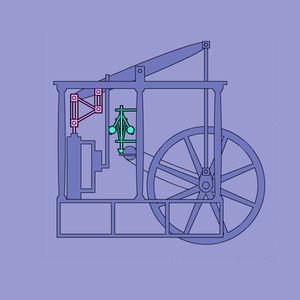
This engine shows two of James Watt's inventions.
The governor, or 'flyball' governor, was one of Watt's minor but important inventions. It was used to control the speed of the engine. If the engine started to run too fast, the governor would spin fast too, and the balls would swing out. This closed the steam valve to the engine, shutting off the supply of steam until the engine slowed down again.
James Watt's parallel motion mechanism replaced the chain that connected the piston to the beam in earlier engines. The mechanism enabled the piston to push straight up and down while the beam traced the shape of an arc.
People
The advent of steam power caused horrendous accidents in farming. Many were caused by boiler explosions when poor maintenance was often to blame. Bell’s Weekly Messenger of 1860 reported one such occurrence:
“One of those fearful boiler explosions, which occasionally we've had to deplore, occurred on Monday last at Stanton Wyville, a small village in Leicestershire.
It appears that Mr. Dunmore, a farmer residing in the neighbourhood of the village, hired a small portable engine, which was in bad working order, to thrash out corn.The pipe that feeds the boiler was out of repair, which caused the men to stop work twice or thrice, and to patch it up with string and red lead. While the men were repairing the feed pipe, the explosion took place.The engine was blown to atoms, and the men, 13 in number, who were repairing or looking on, were thrown a considerable distance. Three were killed, one of them Thomas Lee was blown over 40 yards into a ditch.
The accident has caused the greatest excitement in the neighbourhood, an inquest has been commenced as to the cause of this calamitous affair.”
Related Videos
You can see this engine on display at Thinktank, Birmingham Science Museum. Find out more.