Electricity Generating Engine, c1894
Introduction
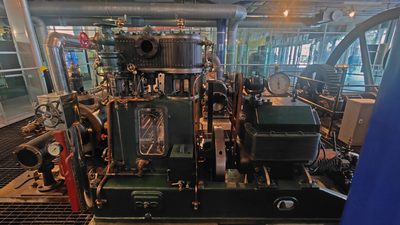
This engine, made in Birmingham, was purchased in 1894 to light up the works of Robert and William Henry Symington, a corset maker in Market Harborough.
The process was so intricate that the 500 workers needed very bright lighting to see what they were doing. Similar engines were also used for lighting aboard Royal Navy ships. Generating electricity requires a very fast engine. It was only when this engine, with its special lubrication system, was invented in 1890, that steam engines could go fast enough to generate electricity for lighting homes and factories.
Facts and Figures
- Manufacturer: G E Belliss and Co, Ledsam Street, Birmingham
- Date built: c1894
- User: R and W H Symington and Co, c1894—not known, Jarmain and Sons Ltd, dates unknown
- Period of use: c1894-1950s
- Location: R and WH Symington and Co, Market Harborough, Jarmain and Sons Ltd, Huddersfield
- Engine type: Double acting twin cylinder compound engine
- Power output: 55 horsepower / 41 kilowatts
History
Most steam engines could not run at the high speed required to produce electricity. To solve this problem, Albert Pain a young engineer at Belliss and Company in Birmingham, invented a system called 'forced lubrication' in 1890 which involved pumping oil around the bearings to stop them being worn away. The largest engines of this type were installed at Birmingham's new Summer Lane power station in 1906. Its opening coincided with the extension of electric lighting to the whole city and the electrification of the tramway system. This engine was used to light a corset factory in Market Harborough.
The firm of Robert and William Henry Symington was the creator of the factory-made corset which brought fashion within reach of the whole female population. The tight wasp-waisted corset reached its height in the early 1890s. It was not only a fashion item but also afforded respectability and status to the wearer. The firm's most famous product was the Liberty Bodice introduced in 1908. Designed to replace the corset, the new knitted material was advertised as still providing support and yet allowing total freedom of movement. Simple enough for a child to put on, it was comfortable, cheap and warm.
What's Special
People
A worker who joined Symington’s in the 1920s commented upon her positive impression of the factory and the complexity of the work:
“I think it was in 1922, I came from Lincoln and I came here to work at Symington's corset factory. It was very nice really, a beautifully clean factory, different to what I thought we were coming to anyway. I'm afraid we were a bit snobbish. I did never told anyone we were coming to work in a factory. Miss Symington in her flowing robes came round, sat on your bench and had a word with you. She came round like a ship in full sail, she swept through those rooms.
Of course in those days you didn't go straight onto a job you were going to be on, it was more or less graded. A stitching job in Symington's was a skilled job because you had to assemble the things and you had to know which bits to put together. In some parts there were as many as 10 or 12 different pieces to put together for a corset and then out to be strapped.”
You can see this engine on display at Thinktank, Birmingham Science Museum. Find out more.