Factory Engine, 1924
Introduction
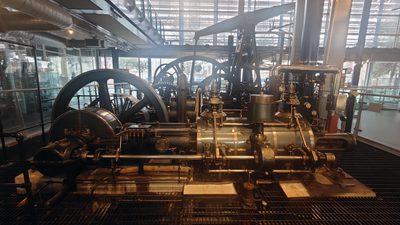
This engine was used to power all the machinery at the Hovis Mill in Macclesfield from 1924 until 1954. At this time the mill produced Hovis baking tins, flour bags and even advertisements — everything in fact apart from flour. Hovis first printed its famous advertisements at the Macclesfield Mill in 1895.
Engineers were always looking for ways of making steam engines more efficient. This engine's design meant that it was more powerful than other engines which used the same amount of fuel. Its very high speed produced a very efficient flow of steam.
Facts and Figures
- Manufacturer: Galloways Ltd, Manchester
- Date built: 1924
- User: Hovis Ltd
- Period of use: 1924-c1954
- Location: Hovis Mill, Macclesfield
- Engine type: High speed uniflow engine
- Power output: 80 horsepower / 60 kilowatts
History
This engine, built by Galloways Ltd of Manchester, was one of the most efficient of its time. It was capable of ten times the speed of a beam engine. The engine ran the entire Hovis Mill for ten hours a day, including the machinery for making paper bags, printing advertisements and producing baking tins. It also drove two generators, one for lighting and the other for the coach building department. Enormous quantities of goods were produced. In 1931, ten paper bag making machines were turning out two million bags a week. One hundred million advertisements of all kinds were produced annually.
Hovis flour began life as 'Smith's Patent Germ Flour', patented by Richard Smith, in 1887. It was marketed by S. Fitton and Son of Macclesfield who launched a competition to find a new name for their increasingly popular bread. The winner was Mr Herbert Grimes, a London student, who came up with the name Hovis. 'Hovis' comes from the Latin 'hominis vis', meaning the strength of man. Hovis flour first went on sale in 1890. Hovis bread was always baked in many bakeries around the country – the flour and the baking tins still need to be bought from the company today.
What's Special
People
In 1947, Mr Dence, the Chairman of Hovis recalled the small beginnings of the printing department and its rapid development:
“The printing department we know today is the result of a proposition put before the directors in 1895. With a small printing plant of their own, it was suggested the company's salesman could offer their customers a service which would be useful to the customers and profitable to the company. This suggestion was accepted and a small printing plant was bought and installed the same year. Accommodation for the new venture was found on the ground floor of the mill at Macclesfield.
How many, one wonders, foretold at that time even a part of the growth it was to make so soon and thereafter so consistently? It was indeed apparent almost at once that the plant was not large enough to execute the orders our salesman was sending in and before the year was out, the first additional machinery arrived. More was added during the next three years, increasing the department's capacity and the range of goods it had to offer.
In 1900, a new machine arrived which was to start up the most successful enterprise of all, the manufacture and printing of Baker's paper bags. This venture was a success from the beginning. Our friends would be surprised and our competitors astonished if they knew how many paper bags have been made in Macclesfield, since that first machine arrived 47 years ago.”
You can see this engine on display at Thinktank, Birmingham Science Museum. Find out more.