Gas Pumping Engine, 1860s
Introduction
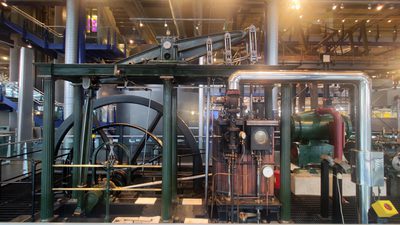
This engine was used in London at the Old Kent Road Gas works by the South Metropolitan Gas Company from 1864 until the 1950s.
Coal was burnt in an oven to produce the gas. The engine powered an exhauster, a type of fan, which drew off the gas and pushed it through filters into the gas holders for storage. The six fluted columns symbolised the civic pride which was widely evident in the nineteenth century. The South Metropolitan Gas Company was a leading gas company in the nineteenth century. It pioneered cheap gas for all and a profit-sharing scheme with its workers.
Facts and Figures
- Manufacturer: Eastern Amos Ltd, London
- Period of use: 1864-mid 1950s
- User: South Metropolitan Gas Company, 1864-1949. Metropolitan Division of South Eastern Gas Board 1949-mid 1950s.
- Location: Old Kent Road Gas Works, London
- Engine type: Compound rotative beam engine
- Power output: 40—70 horsepower / 30—52 kilowatts
History
Steam engines played an important role during the production of coal gas. At each gas works, coal was heated in several large ovens called retorts and gas was given off. A type of fan, an exhauster, drew the gas away from the retort and pushed it through a series of filters to remove impurities. The gas then entered large gas holders before being piped away for public use. The South Metropolitan Gas Company purchased this engine in 1864 to drive two exhausters at its Old Kent Road works. Each exhauster pumped up to 70,750 cubic metres of gas daily.
In 1792 William Murdock succeeded in the first practical application of gas lighting, at his home in Redruth, Cornwall. As an employee of Boulton and Watt he was responsible for the first public demonstration of gas lighting when the Soho Manufactory was illuminated for the peace celebrations in 1802. Birmingham's first gas company was the Birmingham Gas Light and Coke Company established in 1819. Even in the early days, competition between gas companies was fierce. There were complaints about the tapping of gas supplies, and considerable annoyance was caused by companies breaking up the streets to lay pipes.
George Livesey, Chairman of the South Metropolitan from 1885 until 1908, was known as the 'father of cheap gas'. He encouraged the spread of the 'penny in the slot' meter which made gas available to every home. The company was renowned for paying its employees more than any other gas company, giving shareholders a larger dividend and charging the least for gas. It was also famous as the first gas company to introduce a co-partnership scheme. In 1889, it was proposed that workers who agreed not to strike would receive an annual bonus. By 1908, £427,000 had been paid out.
What's Special
People
Mrs Mayvine worked as a slot meter repairer in London. She was based at the Old Kent Road works from 1917-1918:
“I had to go into the workshops first at Old Kent Road to be taught the different things about the meter. All the different meters have got different wheels and I had to learn which one was which. There were so many people running away at that time because of the air raids. They would come back and they wanted to use their meters, didn't they? We used to have to go and solder the new staples on if they'd broke the meter and put new wheels on, that sort of thing. We used to have to disconnect the meter, turn the gas off and then put up your connecting pipe so we could get the light from the gas stove to our soldering irons because we had to solder the staples on. Some women worked on the coke heap, loading up bags of coke. That was a nasty job. A dirty job really.”
You can see this engine on display at Thinktank, Birmingham Science Museum. Find out more.