Portable Engine, 1894
Introduction
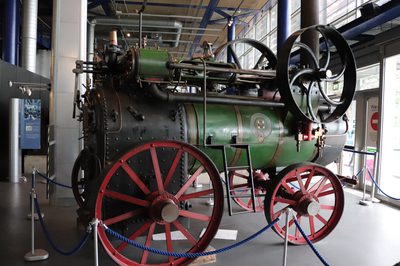
This engine was built by Ruston Proctor Ltd of Lincoln in 1894.
It was used to power a saw to cut stone blocks for the Caban Coch Dam. Between 1893 and 1906, three huge dams were built in the Elan Valley in Wales to supply Birmingham with its water. A 118 kilometre long pipeline carried water from the reservoirs into Birmingham.
Portable engines of this type were towed by horse or traction engine to wherever they were needed and connected by belts to drive machines. They provided people with a really convenient and flexible source of power for the first time.
Facts and Figures
- Manufacturer: Ruston Proctor Ltd, Lincoln
- Date built: 1894
- User: Birmingham Corporation Water Department
- Period of use: 1894-c1953
- Location: Mason's Yard, Elan Valley
- Engine type: Two cylinder portable engine
- Power output: 12 horsepower / 8.9 kilowatts
History
Steam power was vital during the construction the Elan Valley dams. Every day steam locomotives hauled trains with 1,000 tonnes of building materials into the valley. Stone cutting saws, rock crushers and massive steam cranes prepared the stone and lifted it into position. This engine powered a stone cutting saw at Mason's Yard near the Caban Coch Dam. Two local quarries supplied most of the 144,000 cubic metres of stone required. The dam was 186 metres long and 37 metres high. The engine survived for many years because it was used to store compressed air at the Elan Valley works.
Towards the end of the nineteenth century, Birmingham was running out of water. The size of the population and the area to supply grew rapidly. Between 1875 and 1895, daily water consumption doubled from 35 to 70 million litres. A report in 1871 had concluded that the area around the Elan and Claerwen rivers in mid-Wales was best suited to supplying Birmingham's water. The Birmingham Corporation Water Act was passed by Parliament in 1892 authorising the construction of the dams and pipeline to the city. Costing £6 million, it was the largest and most expensive water supply scheme in Britain.
Construction began in 1893 and took 13 years. It involved thousands of workers and a village was built especially at Elan to house some of them. By 1895 there were a thousand workers and tradesmen in the village. Among the facilities were a hospital, school, recreation hall and canteen. The school was designed to take about 150 pupils, but soon had over 200. A large extension was built and more teachers appointed. The canteen was the centre for entertainment with up to 150 men attending each night.
The Elan Valley waterworks were opened by King Edward Vll and Queen Alexandra on 21 July 1904. Within a year the 100 million litres of water a day required in Birmingham were being supplied from the Elan Valley. Due to increasing demand, a fourth dam was built across the River Claewen between 1946 and 1952. By the mid 1950s more than 225 million litres of water were needed each day to meet the needs of Birmingham's people.
What's Special
People
In 1890 Sir Thomas Martineau, Chairman of Birmingham’s Water Committee, addressed the Council regarding the water supply problem:
“Gentlemen, there has been yet another outbreak of smallpox and diarrhoea in our city. We need pure water. Our existing supplies are woefully inadequate. We depend on local wells and rivers which cannot meet our current needs. Therefore, as chairman of the city’s Water Committee, I propose that we undertake a survey of possible sources of supply, initiate legislation in Parliament, and seek finance to improve the situation for our citizens and industry. For, remember, fellow councillors’, cleanliness is next to godliness.”
You can see this engine on display at Thinktank, Birmingham Science Museum. Find out more.