Rolling Mill Engines, 1820-1840
Introduction
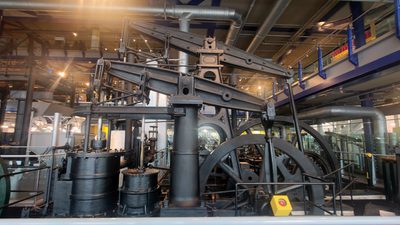
These engines were built early in the nineteenth century for use at Wychall Mill in Kings Norton, Birmingham.
The mill rolled sheets of copper for everything from cutlery to gun cartridges. Before the engines were installed, a water wheel was used to power the rollers. As demand grew, extra rollers were added but the watermill could not provide enough power. The owner added the large steam engine in the 1820s and the smaller one in the 1840s. They continued in use at the mill until it was closed down in 1943.
Facts and Figures
- Manufacturer: Not known
- Date built: c1820 (larger engine), c1840 (smaller engine)
- User: Charles Emery, 1843—c1850. George Ellis and Sons c1850-1943
- Period of use: c1820/c1840-1943
- Location: Wychall Mill, Kings Norton, Birmingham
- Engine type: Double acting rotative beam engines
- Power output: 12—15 horsepower / 9—11 kilowatts each engine
History
Water was an important source of power around Birmingham. In 1860 there were 60 watermills within six miles of the town. Wychall Mill in Kings Norton was converted from a flour mill to a copper rolling mill in the late eighteenth century. In the early days the mill was used to roll Sheffield plate, but also produced copper for cutlery around 1900, or gun cartridges during the Second World War. The steam engines were installed to ensure that a constant supply of power was available for the substantial amount of machinery. It remained in use until 1943.
Since the eighteenth century, Birmingham has been a renowned centre of the manufacture of a huge range of metal goods. Rolling mills produced the large sheets of metal from which hundreds of different items could be cut. The metal was used to make pen nibs, bicycles, buttons, whistles and guns. The skills of the workforce, together with the innovation and adaptability of the companies were legendary. The diversity of materials employed — brass, copper, silver, aluminium or later stainless steel — was also enormous. Great quantities were sent all over the globe, ensuring Birmingham's reputation as the 'Workshop of the World'.
What's Special
People
William Field, aged 15, worked at Charles Clifford’s rolling mill on Fazeley Street, Birmingham. The Children’s Employment Commission interviewed him on 30 December 1840:
“His business here is to receive the sheet of steel as it comes out from between the rollers. If boys who exclusively do this work are not careful and attentive, their fingers are liable to be cut. The boys have often had their fingers cut. Sometimes they can go on with their work. Sometimes they're laid up for a week.
I has known a boy lose the end of a finger in this way, but in general, no maiming happens.
Two years and a quarter since witness met with a serious incident, witness was employed in cleaning the rollers when the right hand was caught and endeavouring to pull it away with the left that was also laid hold of by the rollers. In consequence of this accident, lost the four fingers of the right hand, the thumb remaining perfect. One finger on the left hand was also lost, together with the use of a second. He's still able to work at receiving the steel, but not so well as formally, as he is often obliged to get the other boys to help him the work required to be done."
You can see this engine on display at Thinktank, Birmingham Science Museum. Find out more.