Textile Engine, 1909
Introduction
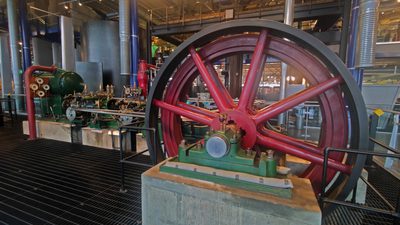
This engine was built in 1909 to train engineers at Victoria University, Manchester. Half the size of the largest mill engines and with only 10 per cent of the power, it was designed to teach students how to solve different engineering problems. The design of the engine adjusted its power if more, or fewer, looms were used at the mill. This kept the pattern of the cloth even.
Steam engines driving thousands of looms revolutionised the textile industry. Manchester, or 'Cottonopolis', was the centre of the world's cotton industry. In 1914 raw cotton imports reached 1 billion tonnes a year.
Facts and Figures
- Manufacturer: Pollitt and Wigzell Ltd, Sowerby Bridge, Yorkshire
- Date built: 1909
- User: School of Civil and Mechanical Engineering, Victoria University, Manchester
- Period of use: 1909-mid 1950s
- Location: School of Civil and Mechanical Engineering, Victoria University, Manchester
- Engine type: Tandem compound condensing engine
- Power output: 60—100 horsepower / 45—82 kilowatts
History
The School of Civil and Mechanical Engineering was established in 1866 at Victoria University, Manchester, to train engineers. In 1909 the facilities were expanded with the purchase of steam, diesel and gas engines. This engine was typical of those used in textile mills and could demonstrate a variety of technical scenarios. For example, engines that operated at full power required large quantities of steam which made them very inefficient. In this engine, special Corliss valve gear regulated the steam supply to the cylinders. It meant that little steam was wasted and the speed of the engine could be closely controlled.
The cotton industry had transformed Manchester into an economic powerhouse by the nineteenth century. Imported cotton from North America and India was woven into cloth in large steam powered mills. In the 1830s almost 50 per cent of British exports were cotton goods. Traders met every Tuesday and Friday at the famous Royal Exchange, the world's biggest trading room, to buy and sell cotton. From a population of only 70,000 in 1800, Manchester had more than half a million inhabitants 50 years later. Ornate warehouses were built for the display of finished cotton goods, many of which can still be seen today.
What's Special
People
By the 1880s, Lancashire produced 82 per cent of all cotton goods worldwide. Speaking at a banquet for the opening of Manchester Town Hall in 1877, MP John Bright could rightly claim he was:
“Standing in a district more wonderful in some respects than is to be traced out on the map and any other kingdom in the world, the population is extraordinary in its number, extraordinary for its interests and industries, for the amount of its wealth, for the amount of its wages, and for the power which it exercises over nations.”
Image gallery
Related Photos
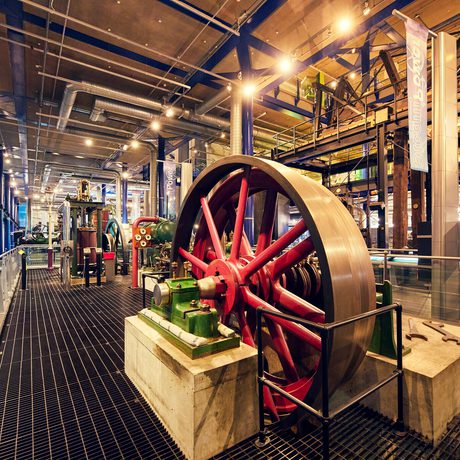


You can see this engine on display at Thinktank, Birmingham Science Museum. Find out more.