News Story
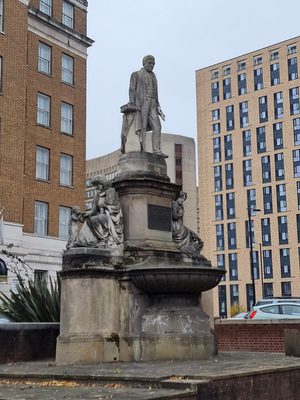
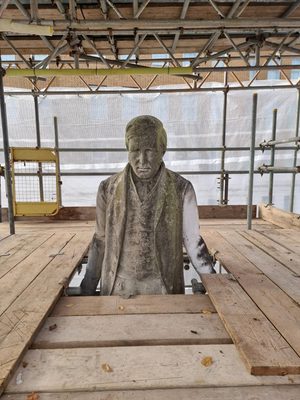
Overlooking the junction at Five Ways, standing in front of the Marriott Hotel, is a large statue of a man, flanked by two female figures. The statue stands on a very high plinth and that, combined with its position at a busy road junction, means that it is easy to miss. It would have been a very different picture when the statue was unveiled on the 4th June 1862, when a crowd of 12,000 gathered to pay homage to the man commemorated by the statue.
So who was this man who could command such affection from the people of Birmingham? He was a Quaker and pacifist named Joseph Sturge. Born in Gloucestershire in 1793, he moved to Birmingham in 1822 and became a grain importer with his brother, although they remained true to their beliefs and refused to sell grain to be used for the production of spirits. Even with this refusal, the business became one of the largest in Britain.
From the 1820s, he became involved with the movement to abolish slavery, alongside his sister, Sophia and in 1826 he was made secretary of the Anti-Slavery Society. He was frustrated by the policy of gradual emancipation and became part of group lobbying for immediate and complete emancipation. The 1833 Slavery Abolition Act was a disappointment as it gave compensation to the slave owners and obliged ex-slaves to become apprentices for six to twelve years. Sturge’s visits to the West Indies proved that the apprenticeship scheme was essentially slavery by another name. His report, which was presented to the House of Commons in 1838, resulted in the ending of the scheme.
He then devoted time and money to the welfare of ex-slaves, supporting schools and helping slaves to settle in free townships. He bought an estate which he ran entirely with freed slaves paid a wage to prove that estates could still be profitable if run in this manner. With others, he formed the British and Foreign Anti-Slavery Society, which survives to the present day as the Anti-Slavery Society. He was also heavily involved in the promotion of peace and travelled to Russia to try to prevent the Crimean war.
In Birmingham, he set up the “Negro Emancipation Rooms”, was involved in education, temperance and the creation of parks and was one of the Street Commissioners. He died in 1859.
His role in the abolitionist movement and his contribution to his adoptive city were valued by the citizens of Birmingham and a statue was commissioned, placed in the part of the city where he had lived.
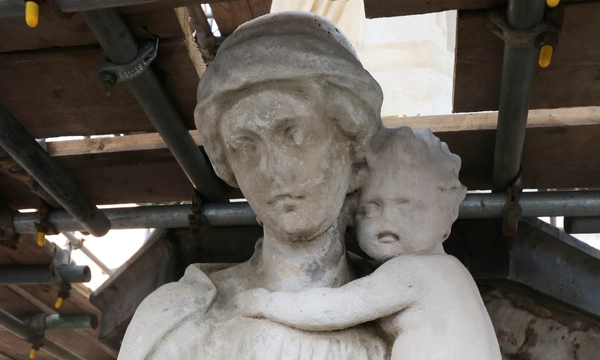
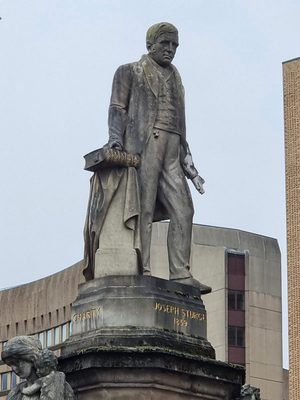
The statue shows Sturge as the central figure, dressed plainly as his Quaker beliefs demanded, with his hand on a Bible. Either side of him are female figures representing Peace with a lamb and olive branch and Charity, comforting a black child. The statue originally had a fountain at the lower levels, sadly the water no longer flows and the fountain bowls are now used for plants.

The statue was conserved in 2007, but the intervening years have seen the stone deteriorate and become soiled with pollution. The statue will be cleaned and protected to enable it to once again become the tribute that it was intended to be. Work commenced at the end of November 2025.
By Jane Thompson Webb,
Conservation Manager
This project is funded by the UK government through the UK Shared Prosperity Fund. The UK Shared Prosperity Fund aims to improve pride in place and increase life chances across the UK investing in communities and place, supporting local business, and people and skills.

For more information about Britain's statues and anti-slavery, we recommend Dr. Nathaniel Adam Tobias Coleman's lectures.