News Story
In case you missed part one (which you can find at Conservation of Joseph Sturge part one) here is a brief recap.
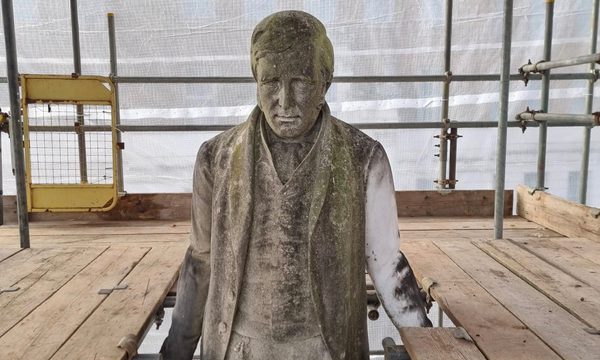
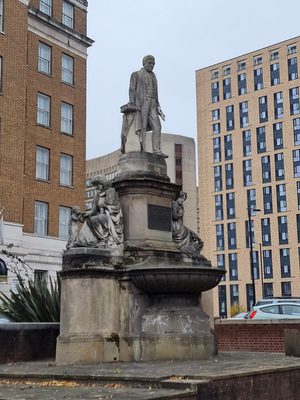
Joseph Sturge was a Birmingham businessman and Quaker, living in the city in the late eighteenth to the mid nineteenth century. He was very involved with the campaign to abolish slavery. A statue commemorating his life and work stands at Five Ways in front of the Marriott hotel. 12,000 people attended the unveiling of the statue in 1862 – he was held in such high regard. These days he seems little known and the statue had suffered from being positioned on what is now a busy road junction. Pollution and the weather had taken their toll on the statue, which had become blackened and detail had become lost.
Stone is a material that we tend to think of as eternal and indestructible. We know that stone was created many millions of years ago and many stone structures, such as Stone Henge, were built thousands of years ago and are still standing today.
Not all stone is the same, however, and some types of stone can be quite fragile. Limestone, mainly made from compressed sea creatures, is formed in layers and this means that it can crumble very easily. Marble is a form of limestone (calcium carbonate) that has experienced heat and pressure and this changes the form of the stone. Marble is commonly used for sculpture as it gives a smooth surface with crisp details. Kept outside, marble is exposed to rain and certain types of marble can react with the acids in rain to form a sandy surface.
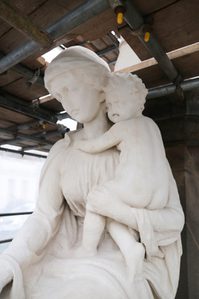
Joseph Sturge is made from limestone (plinth and figures of Peace and Charity) and marble (Sturge). The limestone had become crumbly and had also become a substrate for moss and other microbiological growth. Whilst these growths show that the air in Birmingham is much cleaner than once it was, their presence on stone statuary allows water to penetrate the surface, increasing the rate of damage and obscuring details. The marble used for Sturge is the type that reacts with acid in rain to become sandy.
The statue had been conserved twice before the current treatment. Conservation was undertaken in 2007 and cleaning was carried out in 2013.
By 2025, the statue had become discoloured from pollution and the degradation of previous conservation and was covered in moss and lichen. The gold lettering on the base of the figure of Sturge had corroded (showing that it wasn’t pure gold) and the bronze plaque had ingrained dirt.
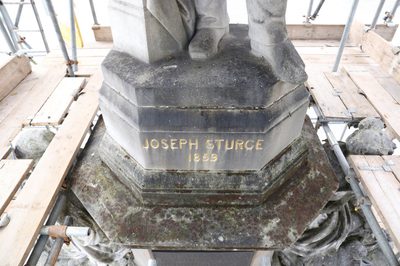
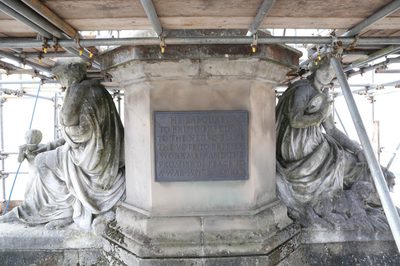
The conservation project aimed to return the statue to a state close to the original appearance and to restore the details. Mareva Conservation undertook the work.
It was a multi-stage process. The first task was to use a stiff brush to remove the moss and microbiological growth, followed by a biocide. Cleaning was undertaken using superheated water and steam. This cleaning had to be carried out two or three times to achieve an even colour in the stone, with a chemical treatment to remove staining. Consideration was then given to how to protect the stone. Cleaning had shown that both the marble and the limestone had damaged surfaces. Without some kind of protection, the damage would get worse. A sheltercoat was applied to both the marble and the limestone elements. This protective layer was a lime-based layer (a calcium carbonate material, the same material as in the sculpture). This protective layer binds to the stone surface and stops the actual surface from becoming damaged.
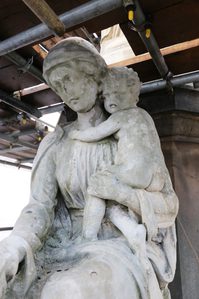
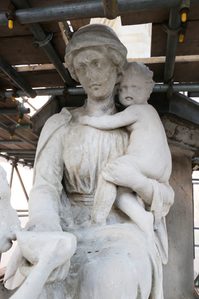
The lettering on the base of Sturge was regilded with 24 carat gold – this will not corrode and it will stay looking gold and shiny for a long time.
The bronze plaque was the last part to be tackled. This was also cleaned with the superheated water and steam process. It had a different protective layer – two types of wax. One was applied hot to ensure that any tiny holes in the metal were filled, the second wax was applied cold and this acted to seal in the hot wax.
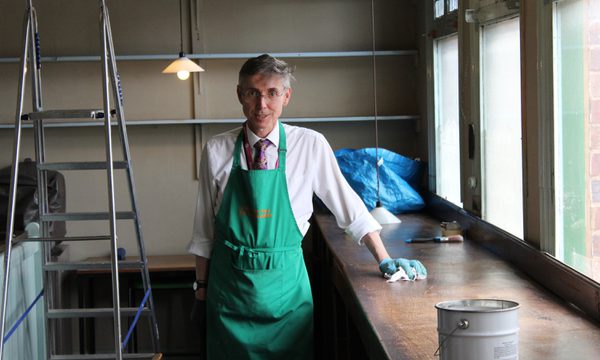
The whole process took four weeks, over November and December 2025, a cold, dark time of the year. What is it like to carry out this kind of work? Birmingham Museum Trust’s conservation placement student worked with Mareva Conservation for a day; these are her reflections on the experience.
“My name is Yifei Xu, and I’m currently a conservation placement student at Birmingham Museum & Art Gallery, training as an object conservator. Shadowing Veronika and Liam on the conservation of the public statue of Joseph Sturge, and working up on scaffolding, was a new and exciting experience for me. My task of the day was hot-waxing the bronze plaque. I warmed the surface with a heat gun before applying a protective layer of wax, let the wax seep into the pores, and finally buffed the surface to a soft sheen. Hot-waxing is a technique we rarely use for museum objects, but I hadn’t realised how standard and essential it is in public sculpture conservation. What also struck me was how complex and site-specific the work can be. Unlike studio treatments, the working hours are dictated by natural daylight. On my volunteer day, for example, we had to finish earlier than usual museum work hours because the building across the street blocked the light from the setting sun. Other factors such as the porosity of the stone, staining of unknown sources, and undocumented past repairs make the work challenging, but also incredibly fun and rewarding.”
Yifei’s experience illustrates the complexity of a treatment which we classify as “cleaning”. It also shows how complicated it can be to work on objects in-situ. When you next see the statue of Joseph Sturge, spare a thought for the conservators who worked in the cold and the rain to ensure that the memorial can look it’s best.
Jane Thompson Webb,
Conservation Manager.
This project is funded by the UK government through the UK Shared Prosperity Fund. The UK Shared Prosperity Fund aims to improve pride in place and increase life chances across the UK investing in communities and place, supporting local business, and people and skills.

For more information about Britain's statues and anti-slavery, we recommend Dr. Nathaniel Adam Tobias Coleman's lectures.