News Story
By Illustrator Jessica Hartshorn (Jessi Illustrates).
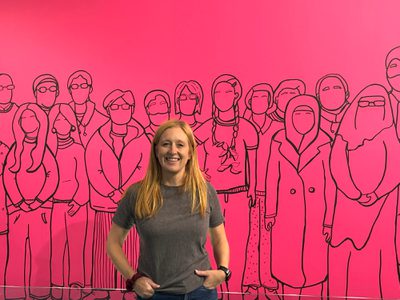
I’ve worked in the museum sector for more than 20 years and have spent the past seven creating murals for heritage and cultural venues. I love painting on a large scale because the giant artwork can bring spaces to life and add character indoors or out.
A mural is generally classed as an artwork painted directly onto a wall or another large, permanent surface. As a mural artist, I take each project from concept to completion, tailoring the design to the client’s brief and transforming a space with themes which range from underwater scenes to tropical rainforests.
For this project, I was commissioned to illustrate a bespoke mural for Birmingham Museum & Art Gallery and Design Penguin of the Galleries citizens’ jury for a new exhibition. The brief asked for a line drawing of 25 real people, with enough detail for each person to recognise themselves without making them identifiable to others. Because the composition was complex and time was limited, I decided to use new tools to help transfer the design.
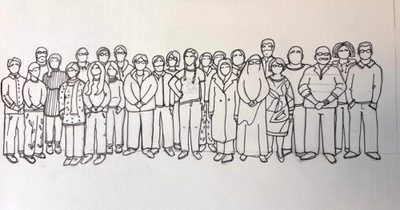
The wall was 5 m wide and had a physical barrier of a glass case in front of it which I had to climb inside or lean over to draw! After preparing the drawing in advance, I uploaded it to my new Meta Quest 3 headset using ‘Contour’, an app designed specifically for mural painting.
The headset projected the artwork onto the wall through the app. I could scale and rotate the image, then adjust its transparency so the wall remained visible.
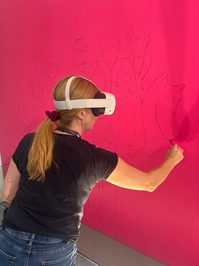
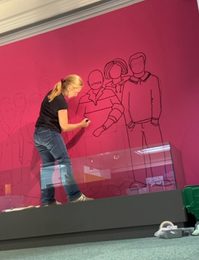
As with a conventional projector, I traced the design onto the wall in chalk, following the lines of my original drawing, switching the projection off at times to check everything was going to plan. The headset as a tool, made the complex composition much easier to map out and dramatically speeded up the process, I completed the design in one day! I returned the next day to refine the drawing and touch up a few areas with pink paint. I was amazed by the ease of use and how using VR gave me more confidence with such a difficult design. It takes a little bit of getting used to and I set a side an afternoon to set up the headset, but once I got going to was pretty straight forward. The only downside was that the app can glitch from time to time very slightly.
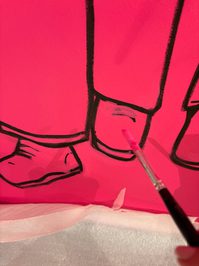
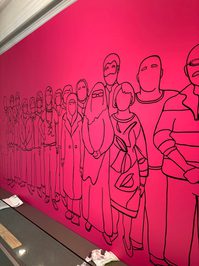
Using a headset offers several advantages. Unlike a conventional projector, the image is not blocked by your body, making the transfer faster and more accurate. It also works in daylight and outdoors, offering greater flexibility and because it is cordless, it doesn’t require a clear projection path, so it can be used in awkward spaces such as stairwells.
The mural forms part of ‘A City that Can’, an exhibition showcasing snapshots of life in Birmingham since the 1950s.
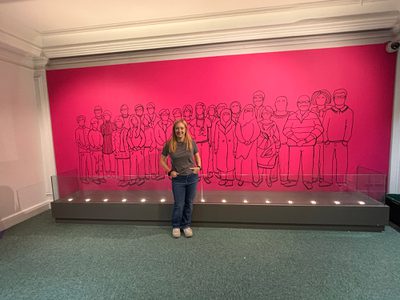
Find out more about Jessica by visiting Instagram @jessi_illustrates or www.jessicahartshorn.com
Watch the Jessica explain the process
Join Jessica as she uses the Meta Quest 3 headset and the contour app to draw the Citizen's Jury mural at Birmingham Museum & Art Gallery.
You might also like...

Birmingham Museum & Art Gallery among local landmarks included on new edition of MONOPOLY: Birmingham
5 November 2026
Shop with a purpose and enjoy 15% off at Birmingham’s museums on Museum Shop Sunday
4 November 2026
New exhibition to open at Birmingham Museum & Art Gallery reflects nearly 100 years of Birmingham through the eyes of father and son artists
28 October 2026